We present.

SpringSky W500

Condensate water production system for irrigation of hydroponic and aeroponic greenhouses disconnected from the water supply system

Watch the video

Introduction

The SpringSky W500 system is an industrial Atmospheric Water Generator (AWG) or atmospheric evaporator type device, which extracts water from ambient humidity through the process of cooling the air below the dew point.

SpringSky W500 exploits the principle of air saturation to its cooling.
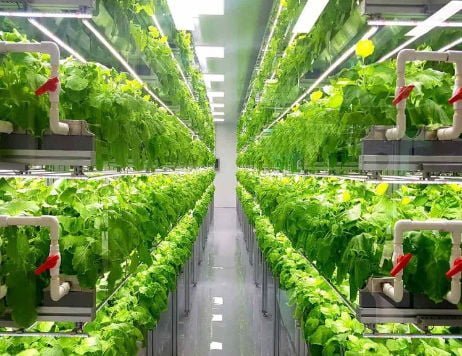
To date, dehumidifiers are used in the indoor growing industry to maintain a constant humidity level inside greenhouses while the goal of this system is to ensure not only the best conditions for plant growth, but also all the water supply the greenhouse needs, an objective that is achieved by using two different condensing units, one located inside the greenhouse, which collects the moisture lost by the plants through transpiration and puts it back into circulation, and another located outside the structure, which collects moisture from the external environment so as to replenish the water used by the plants in their growth cycle.

Normally, commercial AWGs have capacitors that work at maximum efficiency only within specific temperature and humidity ranges. In contrast, the SpringSky W500 system works by exploiting the principle of floating condensation, maintaining maximum efficiency as temperature and humidity change, aided also by variable fan speeds that can be increased or decreased as needed.

System components and functions

  1. The device falls into the class of atmospheric evaporators and its components are:
    1. Blower or fan: draws air inside the greenhouse by passing it through the evaporator and primary condenser of the AWG;
    2. Cold exchanger or evaporator: in this exchanger the refrigerant evaporates by removing heat from the incoming air and condensing moisture;
    3. Compressor: compresses the refrigerant gas to increase its pressure;
    4. Condenser: cools the gas leaving the compressor before entering the evaporator;
    5. Reservoir: collects water to send it, when required, to the fertigation system;
    6. Outdoor unit: consists of an additional condenser and evaporator placed outside the greenhouse for the purpose of lowering the condensing temperature of the refrigerant gas (to improve energy efficiency) and collecting moisture from the outdoor environment (to replenish the water consumed by the plant growth cycle)

Cost, performance and size of the Power Supply Plant

The cost, performance, and size of the system varies especially depending on the source of power supply. To simplify a cost assessment, we analyze only the cases of energy purchase from the national power grid (with a cost estimate of about €0.2 per kWh) and supply from photovoltaic panels (estimated cost for a 25 kWh peak system, enough to power a SpringSky W500 module, of €45,000 plus €15,000 maintenance over a 20-year lifetime).

If we consider a purchase cost for the device of 33,000 € and ordinary maintenance costs of about 500 € annually for filter replacement, extraordinary maintenance costs over a 20-year life of the device of about 6,000 € (gas refills, replacement of any damaged components) and an average daily consumption in the order of 100 kWh we have in the two cases.

Case 1: purchase from the national power grid

Device costs: 33,000 + 10,000 + 6,000 = €49,000
Energy cost: (100 x 365 x 20 x 0.2) = €146,000
Total cost over the 20 years: 146,000 + 49,000 = €195,000
Liters produced in 20 years: 500 x 365 x 20 = 3,650,000 liters
Cost per liter: 195,000 / 3,650,000 = 5.3 cents.€

Case 2: production by agri-voltaic system

Case 2: Production through agrivoltaic system
Device costs: 33,000 + 10,000 + 6,000 = €49,000
PV system cost: (45,000 + 15,000) = €60,000
Total cost over 20 years: 60,000 + 49,000 = €109,000
Liters produced in 20 years: 500 x 365 x 20 = 3,650,000 liters
Cost per liter: 109,000 / 3,650,000 = 2.9 cents.€

In windy areas, with the use of wind turbines, the cost is even lower.

Add Your Heading Text Here

Lorem ipsum dolor sit amet, consectetur adipiscing elit. Ut elit tellus, luctus nec ullamcorper mattis, pulvinar dapibus leo.